Minas Tirith
Minas Tirith, the Tower of Guard, is the seven-walled capital of Gondor, a fortress-city carved into the eastern spur of Mount Mindolluin. It serves as the last great bastion of the Dúnedain in the South against the power of Mordor, and its fate is the central military concern of the War of the Ring. The city is a layered symbol of fading glory, desperate resistance, and the hope of a restored kingship, culminating in the coronation of Aragorn as King Elessar.
Architecture and Layout
Minas Tirith was built on seven levels, each delved into the hill and enclosed by a wall with a single gate. The gates were not set in a line but faced alternately south and north, so that the paved way that climbed towards the Citadel turned this way and that across the face of the hill. Each time it passed the line of the Great Gate it went through an arched tunnel piercing a vast pier of rock. From the rear of the wide court behind the Gate stood up a towering bastion of stone, its edge sharp as a ship-keel facing east, rising even to the level of the topmost circle. The entrance to the Citadel also looked eastward but was delved in the heart of the rock; a long lamp-lit slope ran up to the seventh gate. At the top stood the High Court, the Place of the Fountain, and the White Tower, fifty fathoms from its base to the pinnacle, where the banner of the Stewards floated a thousand feet above the plain. The city was not to be taken by a host of enemies if any within could hold weapons, unless some foe could come behind and scale the lower skirts of Mindolluin. That shoulder, which rose to the height of the fifth wall, was hedged with great ramparts right up to the precipice that overhung its western end, where stood the houses and domed tombs of bygone kings and lords.
History and Decline
By the time of the War of the Ring, Minas Tirith was falling year by year into decay and already lacked half the men that could have dwelt at ease there. In every street great houses and courts stood silent, their doors and arched gates carved with names of great men and kindreds that had once dwelt there, but now no footsteps rang on their wide pavements nor any face looked out from empty windows. The city had been built by the Men of Númenor in the days of their power, and its outward face was like the Tower of Orthanc, hard and dark and smooth, unconquerable by steel or fire. The Guards of the gate were robed in black and wore helms of strange shape, high-crowned with long cheek-guards, wrought of mithril, heirlooms from the glory of old days. Upon their black surcoats was embroidered in white a tree blossoming like snow beneath a silver crown and many-pointed stars, the livery of the heirs of Elendil, which none wore now in all Gondor save the Guards of the Citadel before the Court of the Fountain where the White Tree once had grown.
The Siege and the Battle of the Pelennor Fields
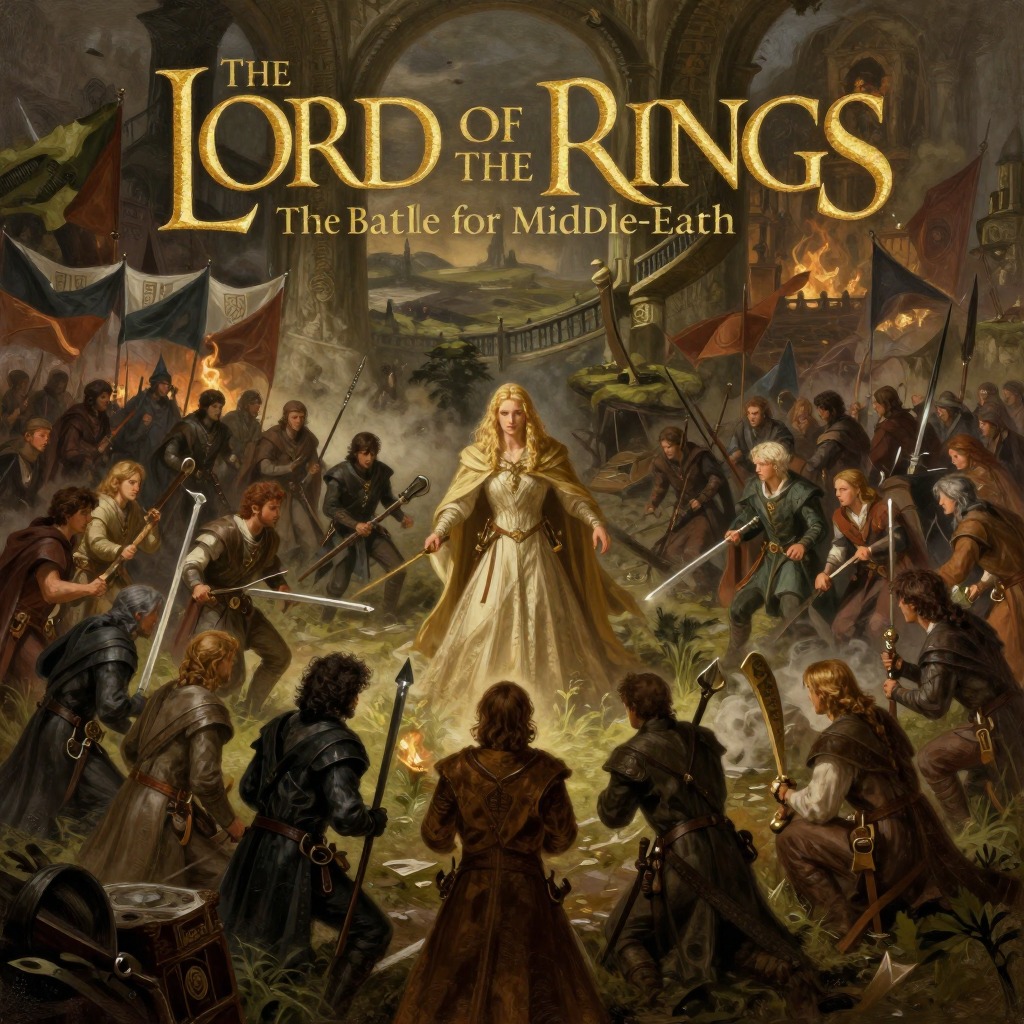
During the siege, the city was encircled by a ring of foes. The Rammas was broken, and all the Pelennor abandoned to the Enemy. The Nazgûl circled above the city, their deadly voices rending the air, filling even the stout-hearted with a blackness so that they thought no more of war but only of hiding and of death. The great Gate of Gondor was assailed by Grond, a huge ram forged in the dark smithies of Mordor, shaped in the likeness of a ravening wolf with spells of ruin laid on it. Thrice the Black Captain cried aloud in a dreadful voice, and thrice the great ram boomed, and upon the last stroke the Gate burst asunder. In rode the Lord of the Nazgûl, but he was met by Gandalf upon Shadowfax, and the horns of the Rohirrim were heard at the coming of the dawn. The battle that followed on the Pelennor Fields saw the fall of Théoden King and the destruction of the Witch-king by Éowyn and Meriadoc. Aragorn, having come with the black fleet from the South, raised the standard of the Tree and Stars, and the tide of war turned.
The Crowning of the King
After the victory, the city was made ready for the coming of the King. The Steward Faramir met Aragorn before the Gate and surrendered his office. Aragorn took the crown from Faramir and gave it to Gandalf, who set the White Crown upon his head. When Aragorn arose, all that beheld him gazed in silence, for it seemed to them that he was revealed to them for the first time, tall as the sea-kings of old, ancient of days and yet in the flower of manhood, with wisdom and strength and healing in his hands and a light about him. The banner of the Tree and the Stars was unfurled upon the topmost tower, and the reign of King Elessar began. In his time the City was made more fair than it had ever been, filled with trees and fountains, its gates wrought of mithril and steel, its streets paved with white marble, and all was healed and made good.